Three ways to exchange goods
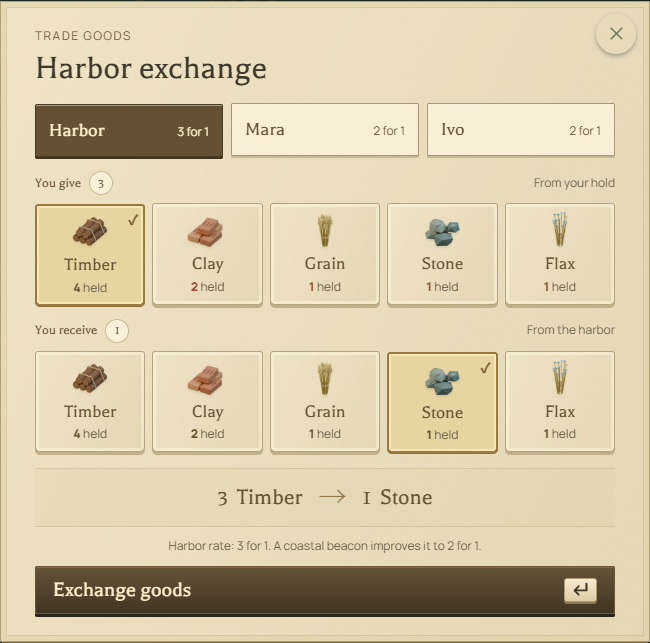
| Trade route | You give → receive | Condition |
|---|---|---|
| Harbor | 3 of one good → 1 other good | Normal exchange |
| Harbor with beacon | 2 of one good → 1 other good | Own a beacon |
| Rival house | 2:1 offer | Rival can spare the requested goods |
Press T to open trade. Rival availability is conditional; an exchange rate does not guarantee a rival has the good you need. Compare the harbor option before committing a construction resource.
Renown is the victory target
Short, Classic and Long voyages require 8, 10 and 12 renown respectively. Villages supply 1 point each, towns 2 per site, and beacons 3 per site. Towns and beacons replace the earlier village value.
For example, two beacon sites and two villages total 8 renown. Adding an enabled charter delivery brings that example to 10. This is a scoring example, not a mandatory build order.
The optional harbor charter
If Harbor charter was enabled during setup, deliver 2 timber + 2 grain + 2 flax once per voyage for 2 renown. The action is separate from ordinary harbor exchange.
Because those goods also fund expansion, compare the delivery with your next village or upgrade. Near the renown target, the charter may finish the voyage; early on, spending the same goods can delay a productive new site.
What a seven does
A seven brings salvage: choose 2 units of one resource, then move the squall to a different productive tile. The blocked tile stops producing until the squall moves again. The field guide states that your hold stays safe.
Do not import a discard-half rule from another board game. Resolve Tidemark’s own salvage-and-squall prompt, and check whether the destination tile will block one of your productive homes.
Need to expand instead? Return to building costs or review the opening sequence.